
Lens Test Shots & Articles
Helios 44 Guide: Versions, Swirly Bokeh and Adapting to Mirrorless

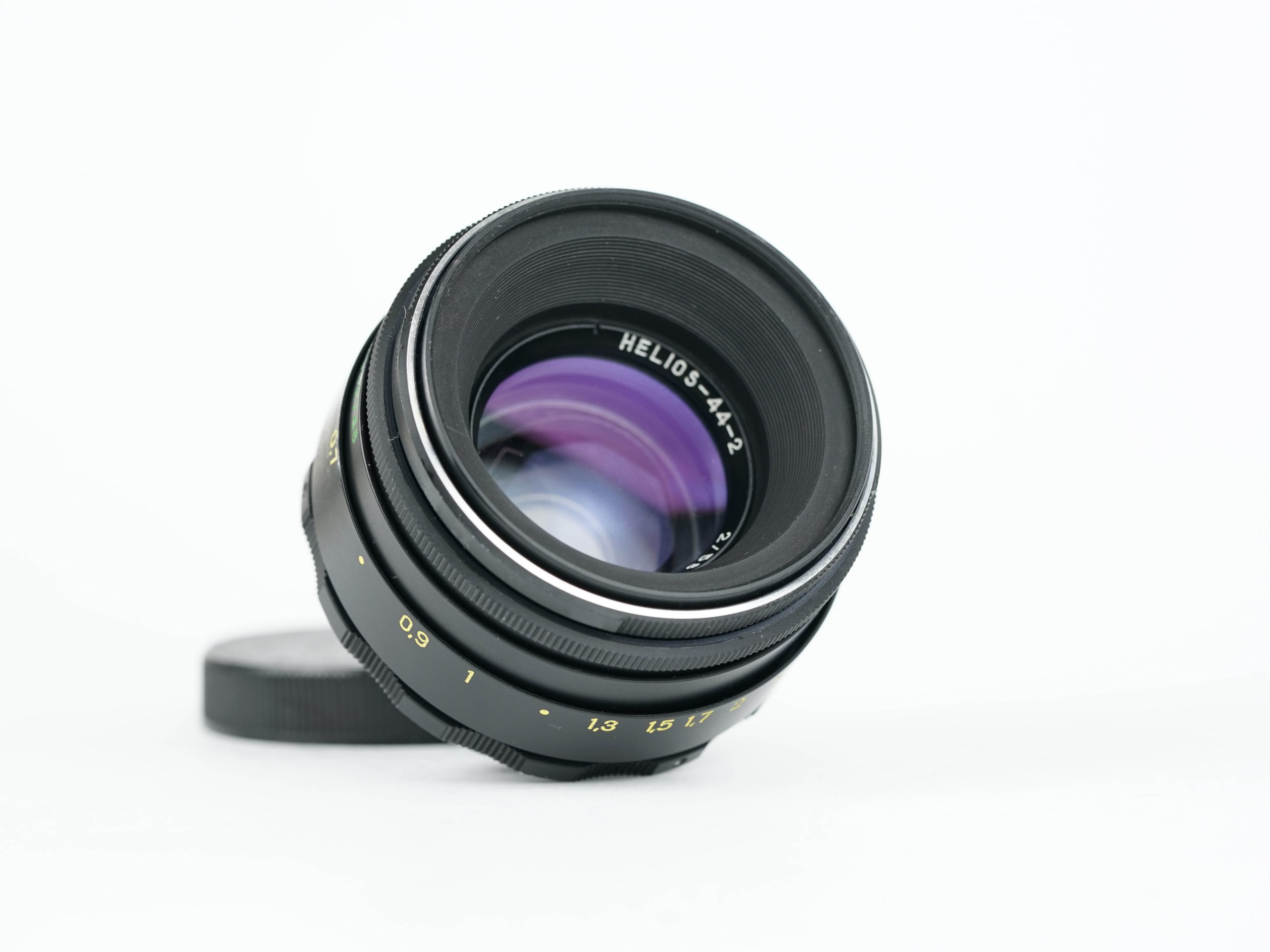
The Helios 44 is one of the most produced lenses in history and probably the most popular Soviet lens today. It is a 58mm f/2 standard lens based on the Zeiss Biotar optical design, and it became famous for one thing above all: its swirly bokeh. In this guide we explain the main versions, how to get the swirl and how to use a Helios 44 on a modern camera.
The main Helios 44 versions
All Helios 44 lenses share the same basic formula – 58mm, f/2, six elements – but the mechanics changed over the decades.
- Early Helios 44 (13 aperture blades). The early versions were made in M39 (Zenit thread) and M42 mount and have 13 aperture blades, which keep out-of-focus highlights round even when you stop down. These are the most collectible versions – see our Helios 44 13 blades for Start and the rare KMZ Helios 44 Red P.
- Helios 44-2 (8 blades, preset aperture). The most common version, in M42 mount. It has a preset aperture: one ring sets the target f-stop, the second ring opens and closes the diaphragm smoothly without clicks. This makes it a favourite for video. Browse our fully serviced Helios 44-2 lenses.
- Helios 44M series (44M, 44M-4, 44M-5 and later). These versions have an automatic diaphragm for Zenit cameras, usually with an A/M switch. On an adapter, simply use M (manual). Later versions are also multicoated, which gives a bit more contrast and resistance to flare. Example: Helios 44M-5.
Why does the Helios 44 swirl?
The swirl comes from the optical design: the field is curved and the out-of-focus highlights at the edges of the frame are stretched into oval, “cat’s eye” shapes. Together they form a circular pattern around the subject. Modern lenses are corrected to avoid this – the Helios is not, and that is exactly why people love it.
How to get the swirly bokeh
- Shoot wide open at f/2 – the effect fades as you stop down.
- Keep your subject at about 1.5–3 metres and the background much farther away.
- Choose a busy background with small highlights: leaves with sunlight coming through, city lights, Christmas lights.
- Side light or backlight makes the highlights brighter and the swirl stronger.
- A full-frame camera shows the full effect. On APS-C the edges are cropped, so the swirl is milder and the field of view is closer to an 85–90mm lens.
Need sharpness instead? Stop down to f/4–5.6 and the Helios becomes a calm, sharp standard lens.
Using a Helios 44 on a mirrorless camera
M42 lenses are easy to adapt because the adapter needs no glass and keeps infinity focus. A simple M42 adapter is available for Sony E, Fujifilm X, Canon RF, Nikon Z, L-mount and Micro Four Thirds. M42 also works on Canon EF DSLRs with a thin adapter.
Early M39 Helios lenses use the Zenit M39 thread, which is not the same as the Leica M39 rangefinder thread. Use an M39 Zenit adapter or an M39-to-M42 ring. The version for the Start camera needs a Start adapter.
What to check before buying
Many Helios lenses are 50–60 years old. Check that the focus ring turns smoothly, that there is no oil on the aperture blades and that the glass is free of haze and fungus. All Helios lenses in our shop are inspected, and most are fully serviced – disassembled, cleaned and re-greased.